When camping, is an eruv required and why?
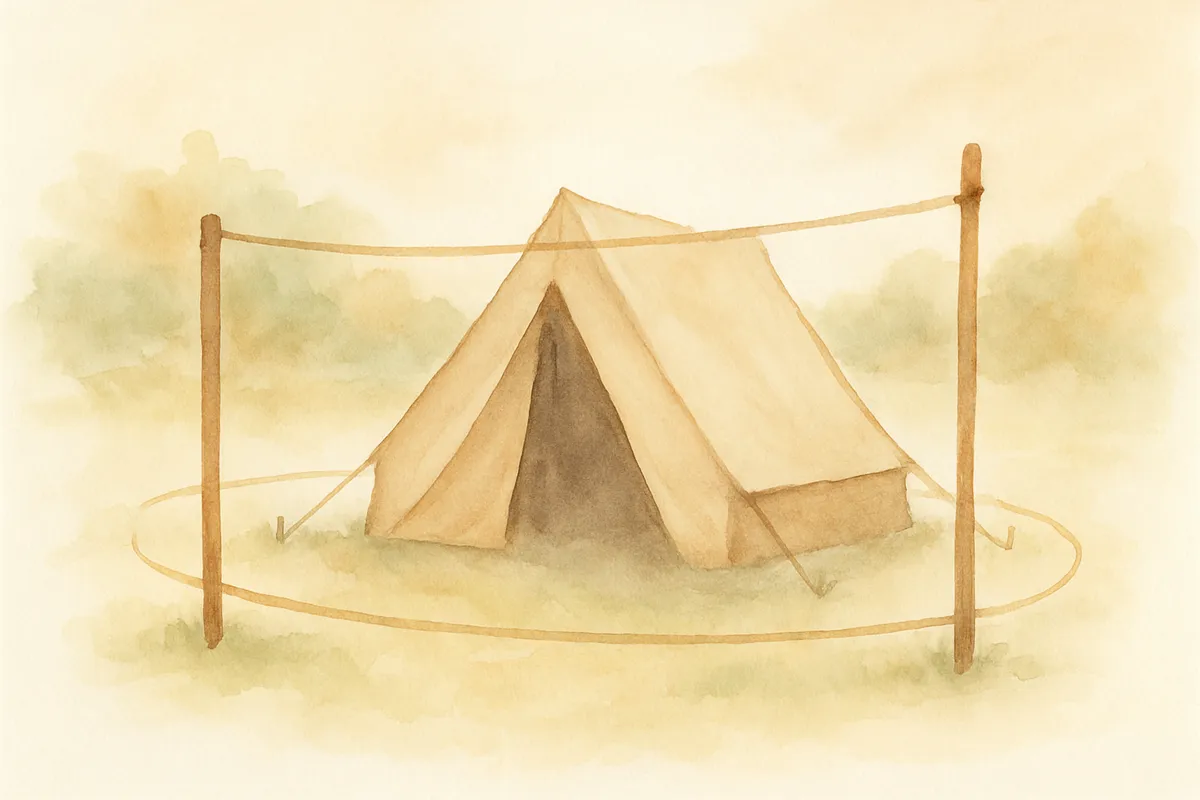
Eruv When Camping: Is One Required?
When camping on Shabbat, the need for an eruv (a halachic enclosure or boundary) depends on the type of camping situation and what activities are involved. In most practical camping scenarios, some form of eruv consideration is relevant — particularly the eruv techumin (boundary for travel) and eruv chatzeirot (enclosure for carrying) — though the specific requirements vary based on where the camp is located and how it is structured.
Key Takeaways
- An eruv chatzeirot (courtyard eruv) may be required to carry objects between tents or communal areas on Shabbat if the camp resembles a shared semi-private domain (reshut harabbim or karmelit).
- An eruv techumin (boundary eruv) is relevant if one wishes to walk more than 2,000 amot (~1 km) beyond the edge of the campsite on Shabbat.
- In open wilderness areas, the camp likely qualifies as a karmelit (semi-public domain), and carrying within it requires halachic attention.
- Carrying in a true reshut harabbim (full public domain) requires a mechitza-based eruv and cannot be solved by eruv chatzeirot alone.
- For practical application on a specific camping trip, a posek (halachic decisor) should be consulted.
Background: The Two Types of Eruv Relevant to Camping
1. Eruv Techumin — The Boundary Eruv
The Torah establishes that the seventh day is a day of rest [Exodus 20:8-10], and rabbinic law limits how far one may walk on Shabbat. The Techum Shabbat (Shabbat boundary) restricts travel to 2,000 amot beyond one's makom shevita (place of residence/rest) — roughly 0.96 km.
If you are camping in a remote area and wish to hike or walk beyond that limit on Shabbat, you would need to establish an eruv techumin before Shabbat. This is done by placing food (enough for two meals) at a point up to 2,000 amot away, effectively "relocating" your Shabbat residence to that point and extending your permitted range in that direction [Eruvin 35a].
The Mishnah in Eruvin notes that if an eruv techumin "rolled outside the boundary" or was destroyed before Shabbat began, it is not valid — highlighting that the eruv must be intact at the onset of Shabbat [Eruvin 35a].
2. Eruv Chatzeirot — The Carrying Eruv
This eruv addresses the prohibition of carrying objects between private and public (or semi-public) domains on Shabbat, derived from the prohibition of melacha (creative work) on Shabbat [Exodus 20:10].
The relevant categories of domain are:
- Reshut haYachid — private domain (e.g., a tent, a fully enclosed space)
- Reshut haRabbim — full public domain (a major thoroughfare with 600,000 people)
- Karmelit — semi-public domain (e.g., open fields, most outdoor spaces)
- Makom Petur — exempt area (small, elevated, or enclosed spaces)
How This Applies to a Campsite
Open Wilderness / National Park Camping
An open campsite in the woods or desert most likely qualifies as a karmelit — a semi-public area that is neither fully private nor a major public thoroughfare. Rabbinic law prohibits carrying in a karmelit just as in a reshut harabbim, to prevent confusion with actual Torah-level prohibitions.
To carry between tents, bring items to a communal area, or move objects around the camp on Shabbat, one would ideally establish an eruv chatzeirot around the campsite — using tzurot hapetach (halachic doorframe-like structures) or natural boundaries (trees, hills, walls) to enclose the area.
Organized Camp / Bungalow Colony
If the campsite is an organized Jewish camp with buildings, fences, or natural enclosures, it may already function as a reshut haYachid or a karmelit that can be enclosed relatively easily. Many Jewish summer camps maintain a formal eruv for exactly this reason.
Tent Interiors
The inside of a tent itself is generally considered a reshut haYachid (private domain) if it is at least 4×4 tefachim and has walls reaching the ground on all sides. Carrying within the tent would be permitted without an eruv. However, carrying from the tent to outside would still be subject to the domain laws described above.
The Underlying Reason: Kavod Shabbat and the Prohibition of Hotza'ah
The prohibition of carrying (hotza'ah) is one of the 39 melachot (categories of forbidden creative work) derived from the construction of the Mishkan [Shabbat 49b]. The Torah's description of Shabbat as a day God rested from all creative work [Genesis 2:1-3] forms the theological foundation:
"וַיִּשְׁבֹּת בַּיּוֹם הַשְּׁבִיעִי מִכׇּל־מְלַאכְתּוֹ" — "And He rested on the seventh day from all His work" [Genesis 2:2].
The eruv system was instituted by the Rabbis to allow practical Shabbat living (carrying food, a baby, a siddur, etc.) while preserving the spirit of the day. Without an eruv, one would be largely immobilized — unable to bring food between tents or carry essential items.
Practical Summary for Campers
| Situation | Eruv Needed? | Type | |---|---|---| | Walking beyond 2,000 amot from camp | Yes | Eruv Techumin | | Carrying between tents in open field | Yes (ideally) | Eruv Chatzeirot / enclosure | | Carrying within a single enclosed tent | Generally no | N/A | | Organized camp with existing eruv | Verify its validity | Both types |
For personal guidance on your specific camping situation — particularly regarding how to construct or verify a valid eruv in the field — consult your local rabbi or posek.
Sources
People Also Asked
Want to dig deeper?