Why can’t Jews eat milk and meat together
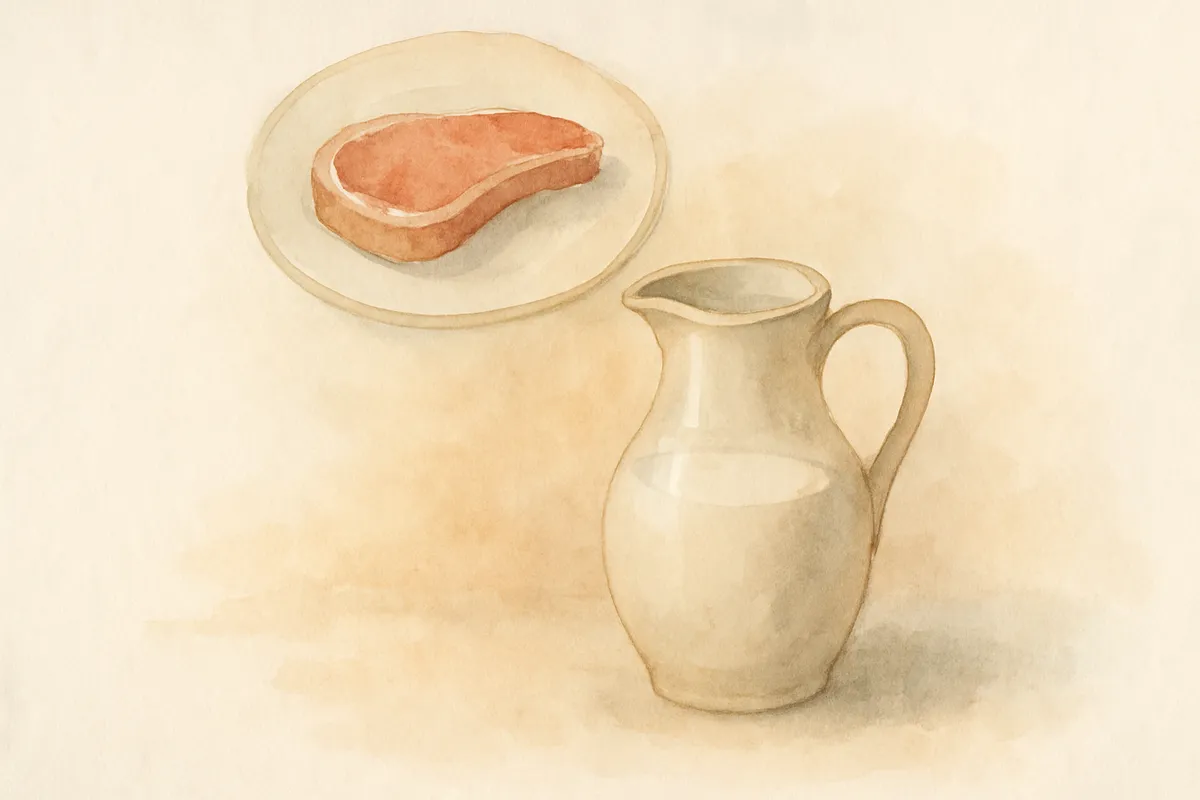
The Torah prohibition against mixing meat and milk derives from a verse repeated three times in the Torah: "לֹא־תְבַשֵּׁל גְּדִי בַּחֲלֵב אִמּוֹ" — "You shall not cook a kid in its mother's milk" [Exodus 23:19; Exodus 34:26; Deuteronomy 14:21]. The Talmud derives three separate prohibitions from this triple repetition: cooking, eating, and deriving benefit from meat and milk cooked together. Rabbinic law (derabanan) further extended these prohibitions to create practical safeguards around the biblical core.
Key Takeaways
- The Torah repeats the prohibition of cooking a kid in its mother's milk three times, from which the Talmud derives three distinct bans: cooking, eating, and benefiting from the mixture.
- The biblical prohibition (d'oraita) applies strictly to domesticated animal meat cooked in domesticated animal milk; poultry and wild animals are rabbinic extensions.
- The Rabbis added waiting periods between meat and dairy, separate dishes and utensils, and other fences to protect the biblical law.
- Some substances that resemble milk — like mei chalav (whey/watery milk residue) — do not trigger the biblical prohibition, though rabbinic restrictions may still apply.
- The custom of eating dairy on Shavuot demonstrates how milk and meat can be eaten sequentially at the same Yom Tov, with proper care taken between them.
The Biblical Source
The foundational verse appears identically in three separate places in the Torah:
"לֹא־תְבַשֵּׁל גְּדִי בַּחֲלֵב אִמּוֹ" "You shall not cook a kid in its mother's milk." [Exodus 23:19; Exodus 34:26; Deuteronomy 14:21]
The Talmud (Chullin 115b) asks: Why does the Torah repeat this verse three times? The Sages answer that each repetition teaches a separate prohibition:
- Bishul — cooking meat and milk together
- Achilah — eating the cooked mixture
- Hana'ah — deriving any benefit from it (e.g., selling it)
This tripling of the verse is the textual anchor for the entire basar b'chalav (meat-in-milk) system of law.
What Is Prohibited Biblically vs. Rabbinically
Not all meat-dairy combinations are equal. The authorities draw careful distinctions:
Biblical Prohibition (D'oraita)
The core Torah prohibition applies when flesh of a domesticated animal (behemah) is cooked with milk of a domesticated animal. This is the plain meaning of "a kid in its mother's milk."
Rabbinic Extensions (Derabanan)
The Rabbis extended the prohibition to additional categories to build a "fence" (seyag) around the Torah:
- Poultry (chicken, turkey, etc.) with milk — There is no mother-child relationship between a bird and milk, so the biblical verse does not technically apply. Nevertheless, the Rabbis prohibited it so people would not become lax about the biblical prohibition.
- Wild animals (chayot) with milk — Similarly extended rabbinically.
- Meat cooked in whey (mei chalav) — The Talmud rules that one who cooks meat in mei chalav (the watery liquid left after cheese-making) is exempt from the biblical prohibition [Chullin 114a]. The Shulchan Arukh (Yoreh De'ah 87:6) codifies this ruling, though rabbinic restriction still applies in practice.
As the Aruch HaShulchan explains:
"Meat of a wild animal or poultry, whether in the milk of a wild animal or a domesticated animal — it is not forbidden by Torah law to eat... therefore it is permitted to cook it, and it is permitted to derive benefit from it, and it is forbidden to eat it by rabbinic decree, so that people should not be careless and come to violate the Torah prohibition of meat-in-milk." [Aruch HaShulchan, Yoreh De'ah 87:8, citing Rambam]
Why the Verse Appears in Context of Bikkurim (First Fruits)
A fascinating textual question arises: why does the prohibition of cooking a kid in its mother's milk appear immediately after the commandment to bring bikkurim (first fruits) to the Temple? [Exodus 23:19]
Several explanations have been offered:
- Rashi and others suggest the juxtaposition teaches that one must not slaughter a mother and its young on the same day (connecting to themes of compassion for animals).
- Some commentators suggest it was a pagan practice to cook a kid in its mother's milk as a fertility ritual, and the Torah prohibits it as a rejection of idolatrous customs (chukkat hagoyim).
- Maimonides (Rambam) in Moreh Nevuchim (Guide for the Perplexed 3:48) explains it on moral grounds — it is cruel and callous to cook an animal in the very milk that was meant to nurture it.
- Others see it as a lesson in tzaar ba'alei chayyim (preventing animal suffering) and sensitivity to natural bonds.
Practical Rabbinic Extensions: The Full System
Beyond the three biblical prohibitions, the Rabbis built an elaborate system:
Waiting Between Meat and Dairy
- After eating meat, one must wait before eating dairy. The standard Ashkenazic practice is six hours; some Sephardic communities wait less.
- After eating hard cheese (aged), many authorities require waiting six hours before meat as well.
- After eating dairy, one need only rinse the mouth and wash hands before eating meat (though Ashkenazic custom often treats this differently depending on the dairy food).
Separate Utensils and Dishes
The Rabbis required separate pots, plates, and utensils for meat and dairy, so that absorbed flavors do not cross-contaminate. [Shulchan Arukh, Yoreh De'ah 87:6]
The Rema (Rabbi Moshe Isserles) adds in his gloss to Shulchan Arukh 87:6 that one should not even mix water used to rinse meat dishes with water used to rinse dairy dishes, to avoid any possible mingling.
Two Tablecloths / Separate Tables
Some authorities require separate tablecloths or a physical separation when meat and dairy are on the same table.
The Case of Shavuot: Dairy and Meat at the Same Holiday
Interestingly, the custom of eating dairy on Shavuot (the holiday of the Giving of the Torah) illustrates how the system works in practice:
"On the first day of Shavuot it is customary to eat dairy foods... since we eat dairy foods and we must also eat meat, because it is a mitzvah to eat meat on every Yom Tov, care [must be taken between the two meals]." [Kitzur Shulchan Arukh 103:7]
The Kitzur Shulchan Arukh explains that the dairy meal and meat meal are eaten sequentially, not simultaneously, with proper separation. One reason given for the dairy custom is that the initials of the verse "Minchah chadashah l'Hashem b'shavuoteichem" spell out mei-chalav — "of milk."
Deeper Meaning: Holiness and Boundaries
At a deeper level (drash and sod), the prohibition of mixing milk and meat reflects a broader Torah theme: preserving the integrity of categories. Just as kilayim (mixed seeds), shaatnez (mixed wool and linen), and other prohibitions maintain boundaries in the natural and spiritual order, basar b'chalav teaches that life-giving sustenance (milk, which nurtures life) must not be mixed with the product of slaughter (meat, associated with death). This boundary between life and death, nurture and consumption, is itself a form of kedushah (holiness).
*For personal guidance
Sources
People Also Asked
Want to dig deeper?