What is the Bedtime Shema prayer?
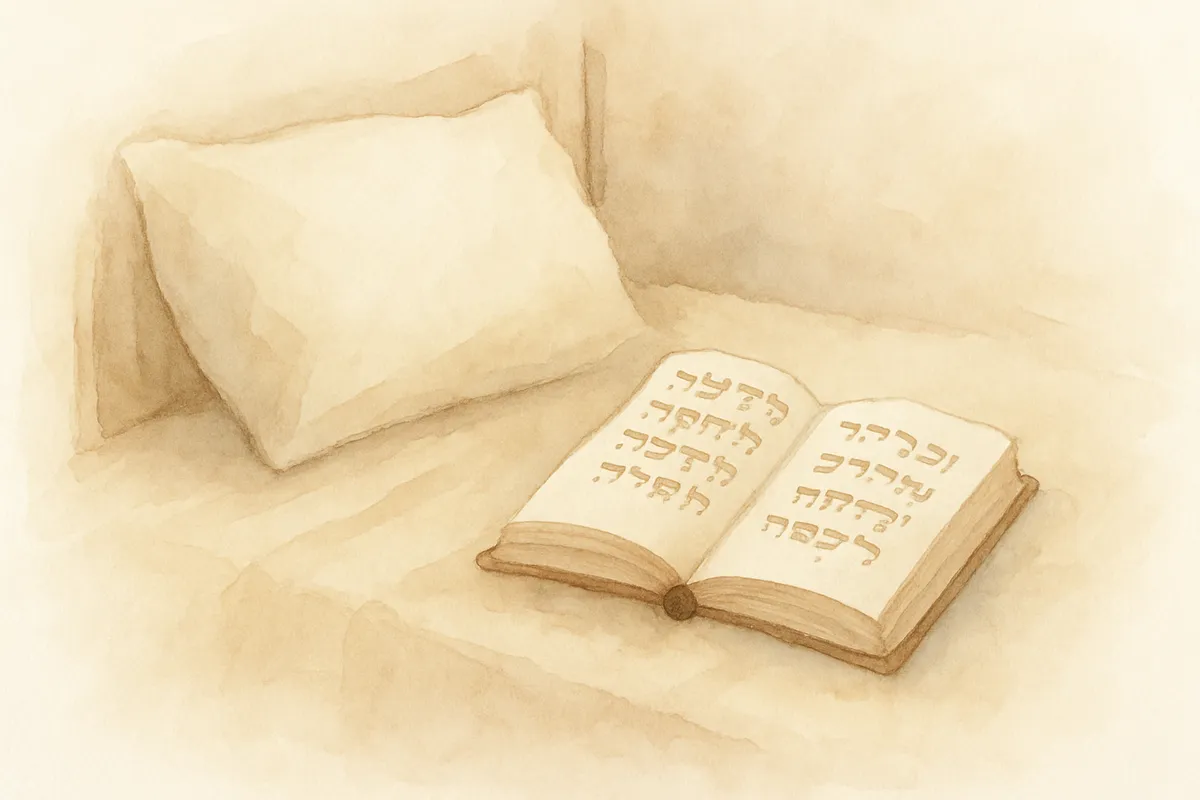
The Bedtime Shema (Kriat Shema al HaMita — the recitation of Shema upon the bed) is the nightly prayer recited just before going to sleep. It is built around the central Jewish declaration of faith — "Hear O Israel, the Lord is our God, the Lord is One" — along with additional psalms, blessings, and protective verses, serving as both a fulfillment of a Torah obligation and a spiritual safeguard for the night.
Key Takeaways
- The Bedtime Shema is one of four daily Shema recitations, and is considered the lowest in spiritual rank among them according to Kabbalistic tradition.
- Its foundation is the Torah commandment to recite Shema "uveshochbecha" — "when you lie down" [Deuteronomy 6:7].
- At minimum, one must recite the first paragraph of Shema; if overcome by sleep, even the first verse suffices.
- The order of blessings (whether hamapil comes before or after Shema) varies by liturgical tradition (nusach).
- One must take special care to recite it clearly, as sleepiness can cause words and letters to be swallowed.
The Torah Source
The obligation derives from the verse in Deuteronomy 6:7:
"וּבְשׇׁכְבְּךָ֖ וּבְקוּמֶֽךָ" — "uveshochbecha uvekumecha" — "when you lie down and when you rise up."
[Deuteronomy 6:7]
This phrase, embedded in the first paragraph of the Shema itself, establishes the twice-daily obligation to recite Shema — once in the morning (Shacharit) and once at night. The Bedtime Shema is associated with the nighttime fulfillment of "uveshochbecha."
The Three Paragraphs of Shema
The full Shema consists of three biblical passages:
- "Shema Yisrael" — [Deuteronomy 6:4–9] — Declaration of God's unity and the commandment to love God with all one's heart, soul, and might.
- "Vehaya im shamoa" — [Deuteronomy 11:13–21] — The promises of reward for observing the commandments and warnings against straying.
- "Vayomer" — [Numbers 15:37–41] — The commandment of tzitzit (fringes) and the memory of the Exodus from Egypt.
Four Daily Shema Recitations — A Kabbalistic View
The Ben Ish Hai (Rabbi Yosef Chaim of Baghdad) teaches that there are actually four daily Shema recitations a person is obligated in:
"צריך להזהר מאד בקריאת שמע שעל המטה, והיא אחת מן ארבעה קריאת שמע שחייב אדם בכל יום והיא הקטנה שבהם במדרגות" "One must be very careful regarding the Kriat Shema upon the bed, and it is one of the four Shema recitations a person is obligated in each day — and it is the lowest among them in spiritual rank."
[Ben Ish Hai, Pekudei 11:1]
The four, ranked from lowest to highest spiritually:
- Kriat Shema al HaMita (Bedtime Shema) — lowest
- Kriat Shema of Arvit (evening prayer)
- Kriat Shema of the Korbanot (morning service liturgy)
- Kriat Shema of Yotzer (Shacharit) — highest
What Must Be Recited?
The Rambam (Maimonides) rules in Mishneh Torah, Laws of Prayer 7:2:
"One reads the first section of Kriat Shema and goes to sleep — even if his wife is sleeping with him."
If a person is overwhelmed by sleep and cannot complete the full first paragraph, it is sufficient to recite at minimum the first verse ("Shema Yisrael...") or psukim (verses) of mercy, and then sleep.
[Mishneh Torah, Prayer and the Priestly Blessing 7:2]
The Blessing of Hamapil
A special blessing, hamapil — blessing God "who causes sleep to fall upon my eyes" — is recited as part of the Bedtime Shema. There is a dispute among the authorities regarding its order relative to the Shema itself:
- The Talmud [Berachot 60b] states that Shema is recited first, then hamapil.
- This order is followed by Nusach Ashkenaz and Nusach Sephard (standard Sephardic rite).
- Nusach Ari (Chabad/Kabbalistic rite) follows the same Talmudic order.
[Mishneh Torah, Prayer 7:2, note 1, citing Berachot 60b; Tur and Shulchan Aruch]
The Challenge of Sleepiness
The Ben Ish Hai highlights a practical spiritual danger unique to this prayer:
"ודא עקא, שבעת שהוא קורא קריאת שמע על המטה על הרוב השינה בין עיניו, ואיכא למיחש פן יבלע תיבות ואותיות" "The problem is that when one recites the Bedtime Shema, sleep is usually between one's eyes, and there is concern lest he swallow words and letters."
He therefore emphasizes that great inner strength (tigboret gedolah) is required to recite it properly.
[Ben Ish Hai, Pekudei 11:1]
Additional Components
Beyond the core Shema, the full Bedtime Shema service (as developed by the Arizal, Rabbi Yitzchak Luria, in Sha'ar HaKavanot) includes:
- Psalm 91 (Yoshev b'seter Elyon) — the great psalm of divine protection
- Hashkivenu — the prayer for God to spread His shelter of peace over us
- Various verses of rachamim (mercy) and forgiveness
- A declaration of forgiveness toward those who may have wronged us
The full order is printed in most traditional siddurim (prayerbooks).
For personal guidance on exactly which version to recite according to your tradition, consult your local rabbi or posek.
Sources
People Also Asked
Want to dig deeper?