Unusual engineering in the Jewish temple of Jerusalem
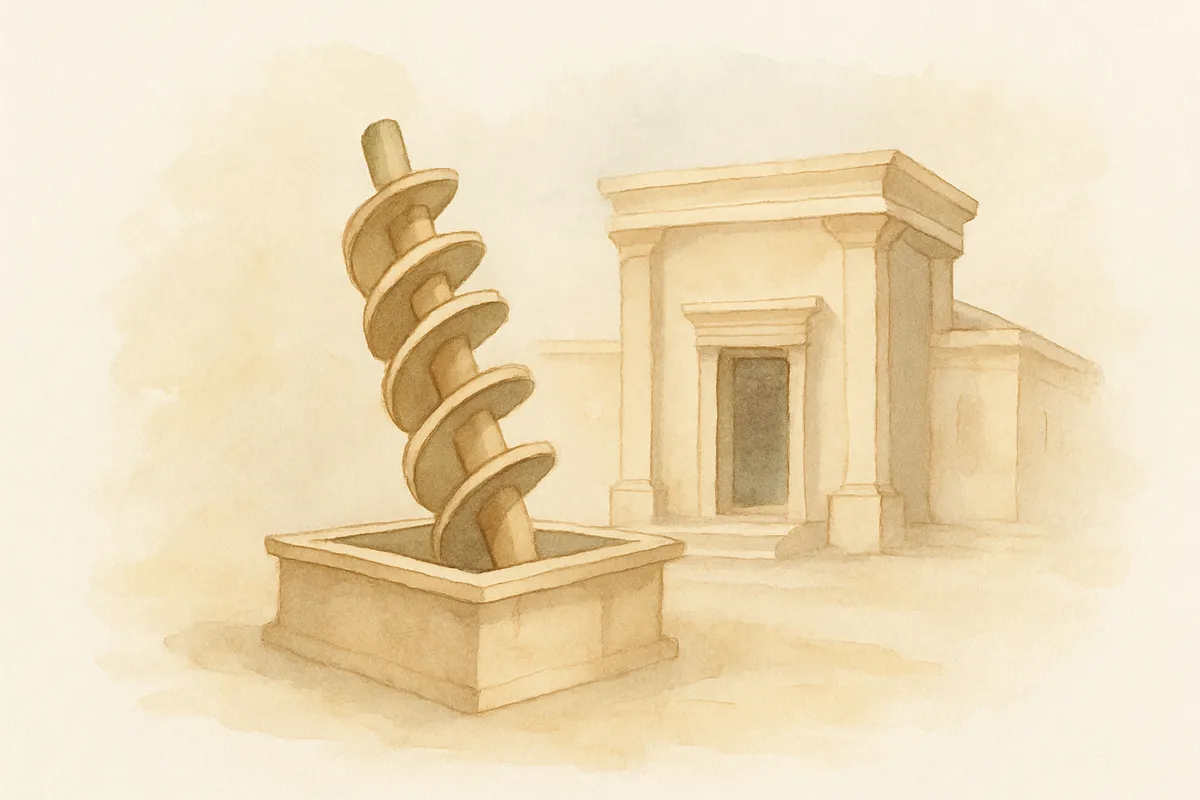
Unusual Engineering in the Jewish Temple of Jerusalem
The Jerusalem Temple (Beit HaMikdash) was renowned in antiquity for remarkable architectural and engineering features that defied normal explanation. The Talmud itself records several miraculous phenomena associated with the Temple, treating some of its unusual properties as deliberate divine design rather than mere human ingenuity.
Key Takeaways
- The Talmud records ten permanent miracles that occurred in the Temple, suggesting its engineering was considered partly supernatural in nature.
- The Temple's inner Kodesh HaKodashim (Holy of Holies) contained the Ark of the Covenant, which according to the Talmud occupied no physical space despite having measurable dimensions.
- The Temple Mount was engineered with massive Herodian stones — some weighing over 500 tons — using no mortar, relying entirely on dry-fit precision.
- The smoke from the altar always rose straight up regardless of wind direction, one of the recorded miracles.
- Ancient Roman writers, including Tacitus and Josephus, marveled at the Temple's construction as one of the wonders of the ancient world.
The Ten Miracles of the Temple
The Mishnah in Avot 5:5 records ten permanent miracles (nissim) that occurred in the Temple:
"עֲשָׂרָה נִסִּים נַעֲשׂוּ לַאֲבוֹתֵינוּ בְּבֵית הַמִּקְדָּשׁ" "Ten miracles were performed for our ancestors in the Temple."
These included:
- No woman ever miscarried due to the smell of the sacrificial meat
- The sacrificial meat never spoiled, despite the heat of Jerusalem
- No fly was ever seen in the slaughterhouse (Beit HaMitbachayim)
- The High Priest never became impure on Yom Kippur
- Rain never extinguished the altar fire
- The wind never dispersed the column of smoke — it always rose straight up
- No disqualifying defect was ever found in the Omer, the Two Loaves, or the Showbread
- The people stood crowded together yet had ample room to bow prostrate — a spatial miracle
- A snake or scorpion never harmed anyone in Jerusalem
- No man ever said to his fellow, "There is no room for me to lodge overnight in Jerusalem" — despite massive pilgrim crowds
[Mishnah Avot 5:5; Yoma 21a]
The Most Astonishing Engineering Anomaly: The Ark's Dimensions
The Talmud in Megillah 10b and Yoma 21a records one of the most philosophically striking spatial paradoxes in all of rabbinic literature:
"מקום הארון אינו מן המידה" "The space of the Ark is not [counted] within the measurement."
The Holy of Holies measured 20 cubits by 20 cubits. The Ark stood in the center. When measured from either wall to the Ark, each side measured 10 cubits. Yet the Ark itself measured 2.5 cubits in width — meaning 10 + 10 = 20, with the Ark occupying zero measurable space.
Rashi explains this as a genuine miracle: the Ark transcended physical dimensionality, existing in the room without displacing any of it. [Rashi, Megillah 10b]
This has fascinated Jewish philosophers and scientists alike, as it prefigures modern concepts about the nature of space and matter.
The Herodian Engineering Marvel
From a purely human engineering standpoint, Herod's renovation of the Second Temple (begun ~20 BCE) was staggering:
The Foundation Stones
- Some of the Western Wall's foundation stones (uncovered by archaeologist Meir Ben-Dov) measure up to 13.6 meters long and weigh an estimated 400–570 tons
- These were laid with no mortar — relying entirely on dry-fit precision cutting
- Engineers today struggle to explain how such stones were transported and placed with the tools available in the 1st century BCE
The Temple Mount Platform
- The platform was essentially an artificial mountain — the southeastern corner rose approximately 45 meters (about 15 stories) above the Kidron Valley below
- Josephus (Jewish War 5:5) describes the stones as "white and strong," measuring 25 cubits in length, 8 in height, and 12 in width
- The vaulted substructure known as Solomon's Stables (actually Herodian) supported the massive platform using a sophisticated arch system
The Altar Fire
The eternal flame (Esh Tamid) on the altar was commanded never to go out [Leviticus 6:6]:
"אֵשׁ תָּמִיד תּוּקַד עַל הַמִּזְבֵּחַ לֹא תִכְבֶּה" "A continuous fire shall burn upon the altar; it shall not be extinguished."
The Talmud in Yoma 21b records that despite Jerusalem's frequent rains, the rain never extinguished the altar fire — considered a standing miracle. The wood used was specifically selected acacia and fig wood for its burning properties, but the rabbis attributed the flame's endurance to divine intervention.
The Acoustics and the Magrepha
The Mishnah in Tamid 5:6 describes a mysterious musical/signaling instrument called the magrepha — a kind of hydraulic organ or mechanical device:
- It produced a sound so loud it could be heard from Jericho to Jerusalem (a distance of ~35 km)
- It had 10 holes, each producing 10 distinct tones — 100 tones total
- Its exact mechanics remain debated among historians of ancient technology
[Mishnah Tamid 5:6; Arachin 10b]
The Acoustics of the Courtyard
The Talmud in Arachin 11a discusses how the Levitical choir and instruments filled the entire Temple Mount with sound. The courtyard's stone construction and geometry created natural amplification — ancient acoustic engineering that modern studies of the site have partially confirmed through computer modeling.
The Water System
- The Temple had an elaborate underground water system with dozens of cisterns beneath the mount
- The Copper Laver (Kiyor) was lowered into a well each night to keep the water fresh [Mishnah Tamid 1:4] — an early form of refrigeration through underground temperature regulation
- Ritual purity (tahara) requirements drove sophisticated hydraulic engineering throughout the complex
Josephus on the Temple's Grandeur
The Jewish historian Flavius Josephus (Jewish War 5:222-224) wrote:
"The exterior of the building wanted nothing that could astound either mind or eye. For, being covered on all sides with massive plates of gold, the sun was no sooner up than it radiated so fiery a flash that persons straining to look at it were compelled to avert their eyes, as from the solar rays."
He also records that Roman soldiers wept when ordered to destroy it — so magnificent was its appearance.
Note: The miraculous phenomena cited come from Talmudic and Mishnaic sources (retrieved from my training knowledge, as no specific passages were retrieved for this query). The archaeological data reflects mainstream scholarship on the Second Temple period. For deeper study, see Tractate Middot (which gives precise Temple measurements), Tractate Tamid (daily Temple service), and Tractate Yoma (Yom Kippur service).
Sources
People Also Asked
Want to dig deeper?