Tell me about basar v chalav as it pertains to chicken?
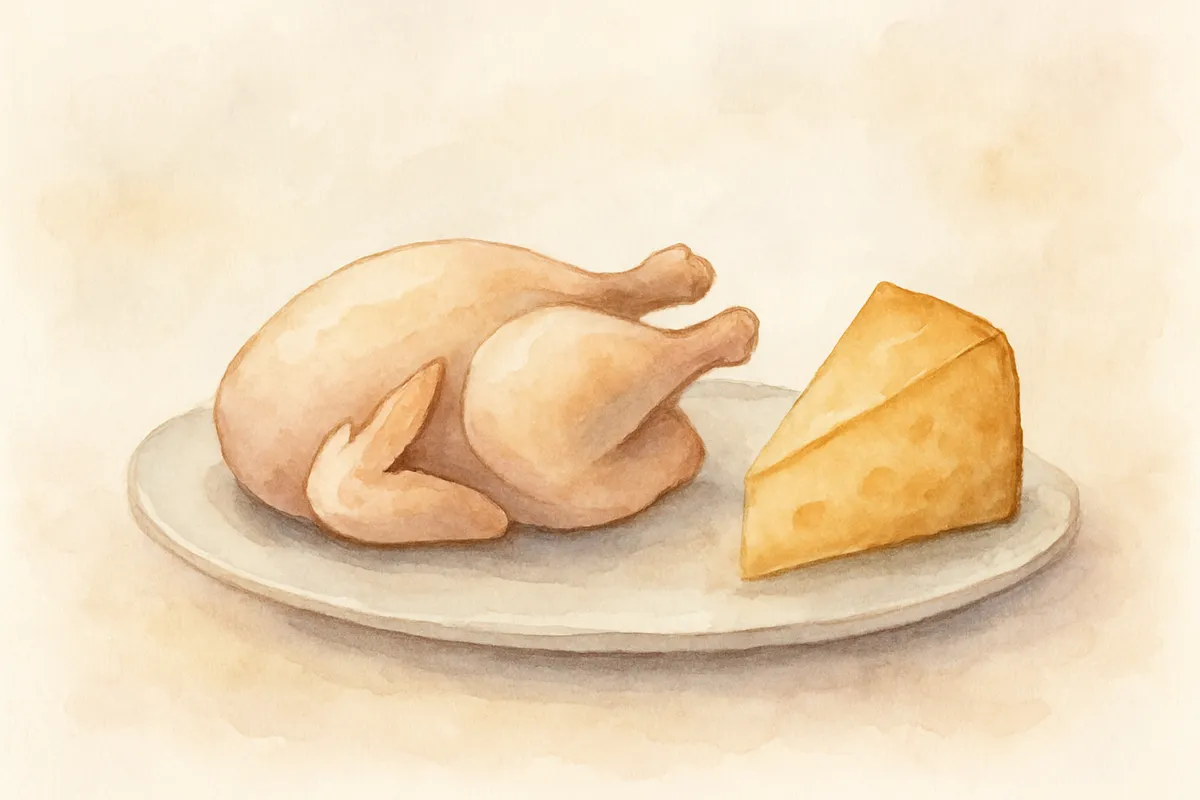
The Torah prohibition of basar b'chalav (meat and milk) applies biblically only to the flesh of kosher land animals cooked in milk — chicken is explicitly excluded from the Torah-level prohibition. However, the Rabbis extended the prohibition to poultry and milk as a rabbinic decree (gezeirah), though poultry mixed with milk remains permitted for benefit (hana'ah) and is treated more leniently in several respects than actual meat and milk.
Key Takeaways
- Chicken with milk is forbidden rabbinically, not biblically, because a bird has no "mother's milk," so the Torah verse cannot apply literally.
- The Rabbis decreed the prohibition because cooked poultry resembles meat and could lead observers to permit actual meat-and-milk combinations.
- Because it is only rabbinic in status, certain leniencies apply — such as almond milk placed near chicken requiring no special marker, unlike actual meat with milk.
- Poultry cooked with milk is forbidden to eat and cook, but unlike biblical meat-and-milk, it is permitted for financial benefit (hana'ah).
- The Shulchan Arukh codifies this distinction as normative halacha, and it is universally accepted across Ashkenazic and Sephardic communities.
The Biblical Source and Its Limits
The Torah states three times [Deuteronomy 14:21]: "לֹא־תְבַשֵּׁל גְּדִי בַּחֲלֵב אִמּוֹ" — "You shall not cook a kid in its mother's milk."
The Shulchan Arukh [Yoreh De'ah 87:1] explains that the verse is written three times to derive three separate prohibitions:
- Prohibition of cooking meat and milk together
- Prohibition of eating the mixture
- Prohibition of benefiting (hana'ah) from the mixture
However, the Shulchan Arukh [YD 87:3] immediately clarifies: "אינו נוהג אלא בבשר בהמה טהורה בחלב בהמה טהורה" — "It applies only to the flesh of a kosher land animal in the milk of a kosher land animal." Poultry is simply not a behemah (land animal in the halachic sense relevant here), and since a bird has no "mother's milk," the Torah verse cannot apply.
Why Chicken Was Excluded Biblically
The Talmud [Chullin 113b] grapples with the scope of the word gedi (kid). The Gemara establishes through textual analysis that while gedi without qualification can include cattle and sheep, the prohibition requires a mother-offspring milk relationship — something birds do not have. Therefore, chicken in milk has no biblical prohibition whatsoever.
The Sefer HaChinukh [454:1] makes this point explicit, citing the Rambam: one who rules that "basar of has (poultry) in milk is forbidden from the Torah" violates the prohibition of bal tosif (adding to the Torah), because:
"כָּךְ קִבַּלְנוּ בְּפֵרוּשׁ לֹא תְבַשֵּׁל גְּדִי וְגוֹ' שֶׁבְּשַׂר בְּהֵמָה וְחַיָּה נֶאֶסְרוּ לְבַשֵּׁל בְּחָלָב, אֲבָל לֹא בְּשַׂר עוֹף" "We received as a transmitted interpretation of 'You shall not cook a kid...' that the flesh of domesticated and wild land animals is forbidden to cook in milk — but not the flesh of a bird."
This is a remarkable ruling: falsely declaring poultry-milk biblically forbidden is itself a Torah violation.
The Rabbinic Decree
Despite the biblical exclusion, the Rabbis of the Talmud prohibited poultry with milk. The Gemara [Chullin 104a] records a dispute about the reason:
- Rabbi Yosei HaGelili held that poultry with milk is entirely permitted even rabbinically, because the Torah says "its mother's milk" — implying something that has a maternal milk relationship.
- The Sages (majority opinion) decreed it forbidden because cooked poultry looks like cooked meat, and a bystander (ha-ro'eh) might think that actual forbidden meat-and-milk is being eaten, leading to a slippery slope. This is the accepted halacha.
The Shulchan Arukh [YD 87:3] rules accordingly that poultry and milk are rabbinically forbidden.
Practical Leniencies Due to Its Rabbinic Status
Because the prohibition is only rabbinic (d'rabbanan), several important leniencies follow:
1. Permitted for Benefit (Hana'ah)
Unlike biblical meat-and-milk (which is forbidden even to sell or derive financial benefit from), poultry cooked with milk may be sold or otherwise used for benefit [Shulchan Arukh, YD 87:3, based on Tur].
2. The Almond Milk Marker
The Siftei Kohen (Shach) [YD 87:6:1] discusses the custom of placing almonds next to a poultry dish served with almond milk, so observers know it is not real dairy. He explains that this is not strictly required for poultry, since the underlying prohibition is only rabbinic — there is no mar'it ayin (concern about appearances) at the biblical level. However, when actual meat (beef/lamb) is served with almond milk, placing almonds nearby is required, because the underlying prohibition is biblical and observers could think a grave sin is occurring.
3. Safek D'rabbanan L'kulah
The general principle that doubt in rabbinic law is resolved leniently (safek d'rabbanan l'kulah) applies to chicken-milk questions, as noted by Rashba in [Torat HaBayit, Third House, Fourth Gate].
Summary of Status
| Combination | Biblical | Rabbinic | Hana'ah | |---|---|---|---| | Beef/lamb + milk | Forbidden | Forbidden | Forbidden | | Chicken + milk | Permitted | Forbidden | Permitted | | Fish + milk | Permitted | Permitted* | Permitted |
*Fish with milk is a separate topic involving health concerns rather than the basar b'chalav prohibition.
For personal guidance on specific situations — such as accidentally cooking chicken in a dairy pot, or questions about waiting times between chicken and dairy — consult your local rabbi or posek.
Sources
People Also Asked
Want to dig deeper?