Replacing a Broken Tzitzit String on a Tallit
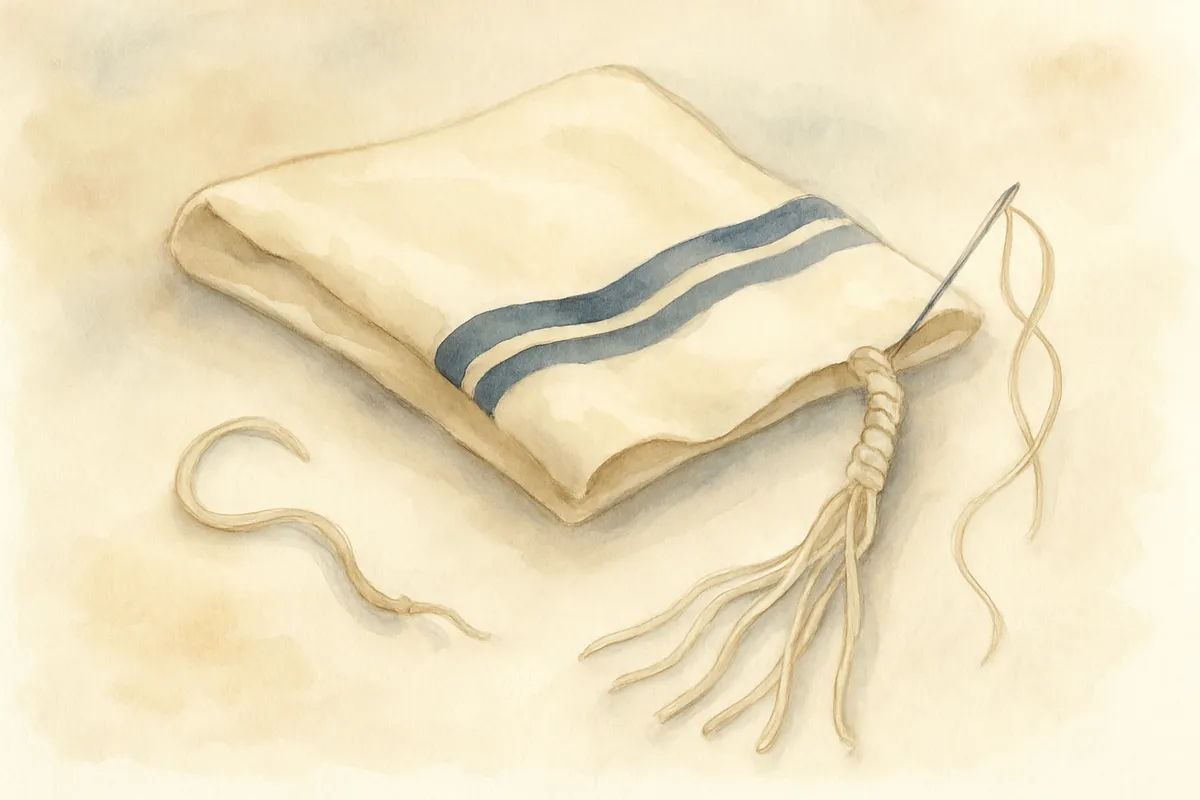
Replacing a Broken Tzitzit String on a Tallit
When a complete string (chatit) tears off from one corner of a tallit (four-cornered garment), the question of whether you may replace just that corner's strings touches on important halachic principles regarding tzitzit (fringes). The short answer is: yes, in most cases you may replace the broken strings on that corner, but there are important conditions and nuances that depend on how and where the string broke.
Key Takeaways
- A tallit with even one corner missing valid tzitzit is considered invalid for the mitzvah, so repair is important.
- If strings break above the minimum required length, the corner can generally be re-strung.
- If strings break at or below the knots, closer to the garment itself, the ruling is more complex and may require remaking the entire corner.
- Replacing strings on one corner does not invalidate the other three corners — you do not need to redo the whole tallit.
- For practical halachic guidance on your specific situation, consult your local rabbi or posek.
Background: The Mitzvah of Tzitzit
The Torah commands in Numbers 15:38:
"דַּבֵּר אֶל־בְּנֵי יִשְׂרָאֵל וְאָמַרְתָּ אֲלֵהֶם וְעָשׂוּ לָהֶם צִיצִת עַל־כַּנְפֵי בִגְדֵיהֶם" "Speak to the Children of Israel and tell them to make for themselves fringes on the corners of their garments."
[Numbers 15:38]
And again in Deuteronomy 22:12:
"גְּדִלִים תַּעֲשֶׂה־לָּךְ עַל־אַרְבַּע כַּנְפוֹת כְּסוּתְךָ" "You shall make twisted cords on the four corners of your garment."
[Deuteronomy 22:12]
Each of the four corners must have valid tzitzit — if even one corner is invalid, the entire garment is disqualified from fulfilling the mitzvah [Menachot 38a].
The Core Halachic Issue: Where Did the String Break?
The key question the poskim (halachic decisors) focus on is where the string broke:
Case 1: String Broke in the "Anaf" (Hanging Part) — Above the Minimum Length
- If the string broke in the dangling portion, and enough length remains (at least a gdil — the length of the thumb joint, approximately 4–5 cm), the tzitzit may still be valid.
- If the remaining length is below the minimum, that string is invalid, but the question is whether the corner as a whole is still valid depending on how many strings broke.
- The Shulchan Aruch (Orach Chaim 12:1) rules that if the majority of strings remain intact, the tzitzit are still valid b'dieved (after the fact).
Case 2: A Whole Set of Strings Came Off the Corner
- If all the strings of one corner came off — as your question describes — then that corner is definitely invalid.
- The Shulchan Aruch (Orach Chaim 15:1) rules that you may add new tzitzit to a garment that already has valid tzitzit on the other corners. The key principle is:
"Tadir v'she'eino tadir, tadir kodem" — but more relevantly here, the principle is that tzitzit on existing corners are not invalidated by fixing a broken corner.
Case 3: Did the String Break at the Hole (Base of the Corner)?
- If the string broke very close to or within the hole in the garment, this is the most stringent case.
- The Mishnah Berurah (15:3) and the Rambam (Hilchot Tzitzit 1:12) both discuss the requirement that the strings be inserted through the hole and that the resulting loops and hanging portion maintain minimum lengths.
- If the knot structure is compromised, one may need to restring the corner entirely, tying new strings through the hole with proper intention (l'shem mitzvah — for the sake of the commandment).
Practical Guidance: How to Restring a Corner
If you are replacing strings on a broken corner:
- Remove all the old strings from that corner (if they are fully invalid).
- Purchase new, kosher tzitzit strings — ideally from a reliable sofer or Judaica store with proper certification.
- Insert and tie with kavanah (l'shem mitzvat tzitzit — intention for the sake of the mitzvah of tzitzit).
- Follow the specific tying tradition of your community (Ashkenaz, Sephardi, Chabad, etc.) as the number of windings and knots differs.
- The other three corners remain valid and do not need to be redone.
A Note on the "Talit She'Halvu Chatiteha" (A Tallit Whose Strings Were Borrowed)
The Talmud in Menachot 41b discusses whether one can "borrow" valid strings from another garment. The ruling is that tzitzit must be made l'shma — with intention — for the specific garment, and strings from a valid tallit cannot simply be transferred. This reinforces that new strings must be properly tied onto the repaired corner.
For personal guidance on your specific tallit and its condition, consult your local rabbi or posek.
Sources
People Also Asked
Want to dig deeper?