Please give me some deeper meaning into the Apple dipped in Honey on Rosh Hashanah
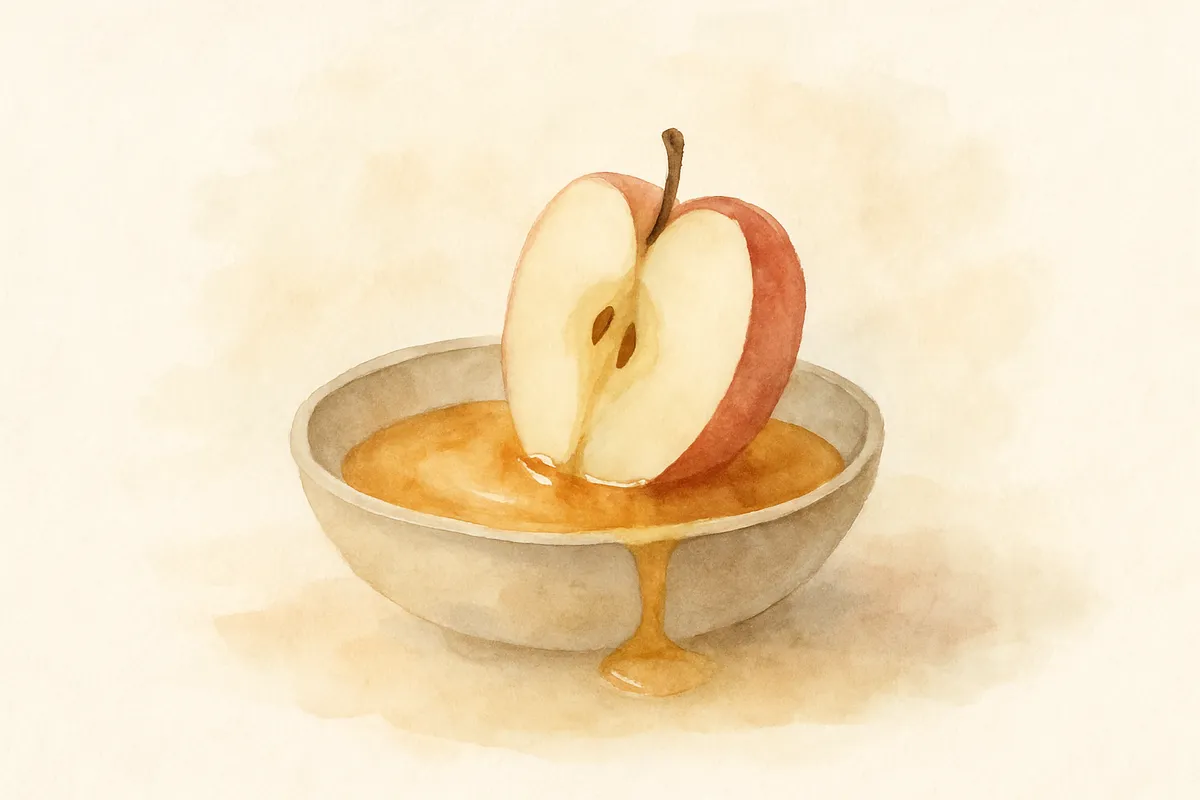
The Apple Dipped in Honey on Rosh Hashanah
The custom of dipping an apple in honey on Rosh Hashanah is one of the most beloved and symbolically rich practices of the Jewish New Year. It is a siman (sign/omen) expressing our heartfelt prayer for a sweet new year, rooted in ancient Talmudic tradition and layered with profound Kabbalistic and philosophical meaning.
Key Takeaways
- The practice derives from a Talmudic teaching that eating symbolic foods (simanim) on Rosh Hashanah serves as an auspicious omen for the coming year.
- The apple specifically alludes to the Shekhinah (Divine Presence) and the Garden of Eden, and is associated with Knesset Yisrael (the Community of Israel) in Kabbalistic thought.
- Honey symbolizes the sweetness and Divine mercy (rachamim) we pray will govern God's judgment of us in the new year.
- The act of dipping — rather than merely eating separately — represents the merging of Israel's nature with Divine sweetness.
- The accompanying blessing requests a "good and sweet year," distinguishing it as a prayer, not merely a culinary preference.
The Talmudic Foundation
The source for eating simanim on Rosh Hashanah comes from the Talmud Bavli [Keritot 6a], where the Amora Abaye teaches:
"Now that you have said that omens are significant, at the beginning of each year a person should accustom himself to eat gourds, fenugreek, leeks, beets, and dates."
The underlying principle is that symbolic acts have the power to open spiritual channels — not through magic, but through the alignment of intention, action, and prayer. The Ran (Rabbeinu Nissim) explains that these acts sharpen our own kavanah (intention) and direct our hearts toward repentance and hope.
Apples and honey specifically, while not listed in Keritot 6a, became the iconic symbol of this practice, mentioned prominently by Maharam of Rothenburg (13th century) and codified in later Ashkenazic tradition.
The Apple: A Garden of Eden Symbol
Pshat — The Plain Level
At the most basic level, the apple is a sweet, fragrant fruit — a fitting vehicle for our prayer for sweetness. Its pleasant aroma adds a sensory dimension to the siman.
Drash — The Homiletical Level
The Maharil (Rabbi Yaakov Moelin, 14th–15th century) connects the choice of apple to a verse in Song of Songs 8:5:
"תַּחַת הַתַּפּוּחַ עוֹרַרְתִּיךָ" — "Under the apple tree I aroused you."
This verse is interpreted as Israel awakening God's love and mercy, making the apple a symbol of the intimate relationship between God and the Jewish people — precisely what we seek to invoke on the Day of Judgment.
Sod — The Kabbalistic Level
The Zohar (Zohar, Vayikra, Emor) describes Gan Eden (the Garden of Eden) as permeated by the fragrance of apple trees, associated with the Shekhinah — the Divine feminine presence. The apple is linked to the sefirah (Divine attribute) of Malkhut (Kingship/Divine Presence), which is fitting since Rosh Hashanah is the coronation of God as King (Yom HaMelech — the Day of the King).
Rabbi Isaac Luria (the Ari, 16th century) taught that when one smells the apple, one can draw down supernal light from the mochin (higher consciousness) associated with Chokhmah (Divine Wisdom). The fragrance of the apple is thus not incidental — it is spiritually activating.
The Honey: Sweetening the Judgment
Pshat
Honey is the quintessential symbol of sweetness in Torah. The Land of Israel itself is described as "אֶרֶץ זָבַת חָלָב וּדְבָשׁ" — "a land flowing with milk and honey" [Exodus 3:8]. To begin the new year with honey is to invoke the sweetness of the Promised Land — a life of blessing and divine favor.
Drash
Rosh Hashanah is described in the Torah [Leviticus 23:24, from our retrieved sources] as "Yom Teruah" — a day of shofar blasts — and as "Zichron Teruah" — a remembrance of the blast. It is the day God judges all of humanity. By eating honey, we are making a physical, embodied prayer: "May Your judgment of us be sweet."
The Tur (Rabbi Yaakov ben Asher, 14th century) notes that the honey also reflects our bitachon (trust) in God — we eat sweetly not because we are certain of a good verdict, but because we trust in Divine mercy.
Sod
In Kabbalah, honey is associated with din (strict judgment) sweetened by rachamim (mercy). The Shelah HaKadosh (Rabbi Isaiah Horowitz, 17th century) teaches that honey represents the transformation of din into chesed — strict judgment becoming loving-kindness. The very act of dipping evokes this alchemical spiritual process.
The Act of Dipping: Unification
Why dip rather than simply eat them together? The Aruch HaShulchan (Rabbi Yechiel Michel Epstein) and Kabbalistic authorities explain that the act of dipping (tevilah, immersion) parallels the concept of immersion and purification — we are immersing our deeds, our year, our very selves into sweetness and Divine mercy.
The Baal Shem Tov (founder of Chassidism, 18th century) taught that the apple represents Knesset Yisrael — the soul of the Jewish people — and the honey represents the Or Ein Sof (the Infinite Divine Light). The dipping is the act of the Jewish soul surrendering itself into the infinite sweetness of God.
The Blessing and Its Deeper Meaning
After dipping, we recite:
"יְהִי רָצוֹן מִלְּפָנֶיךָ... שֶׁתְּחַדֵּשׁ עָלֵינוּ שָׁנָה טוֹבָה וּמְתוּקָה" "May it be Your will... that You renew for us a good and sweet year."
Notice: we ask for a year that is both tova (good) and metuka (sweet). Rav Avigdor Nebenzahl points out that these are not the same thing — something can be good for us but not sweet (like medicine), or sweet but not truly good. We ask God for both: that what is good for our souls also feel sweet to us. This is a profound prayer for alignment between Divine wisdom and human experience.
For personal guidance on how to observe these customs in your home, consult your local rabbi or posek.
Sources
People Also Asked
Want to dig deeper?