If i cut myself and bleed a little bit into something I'm making for dinner, must I throw it out?
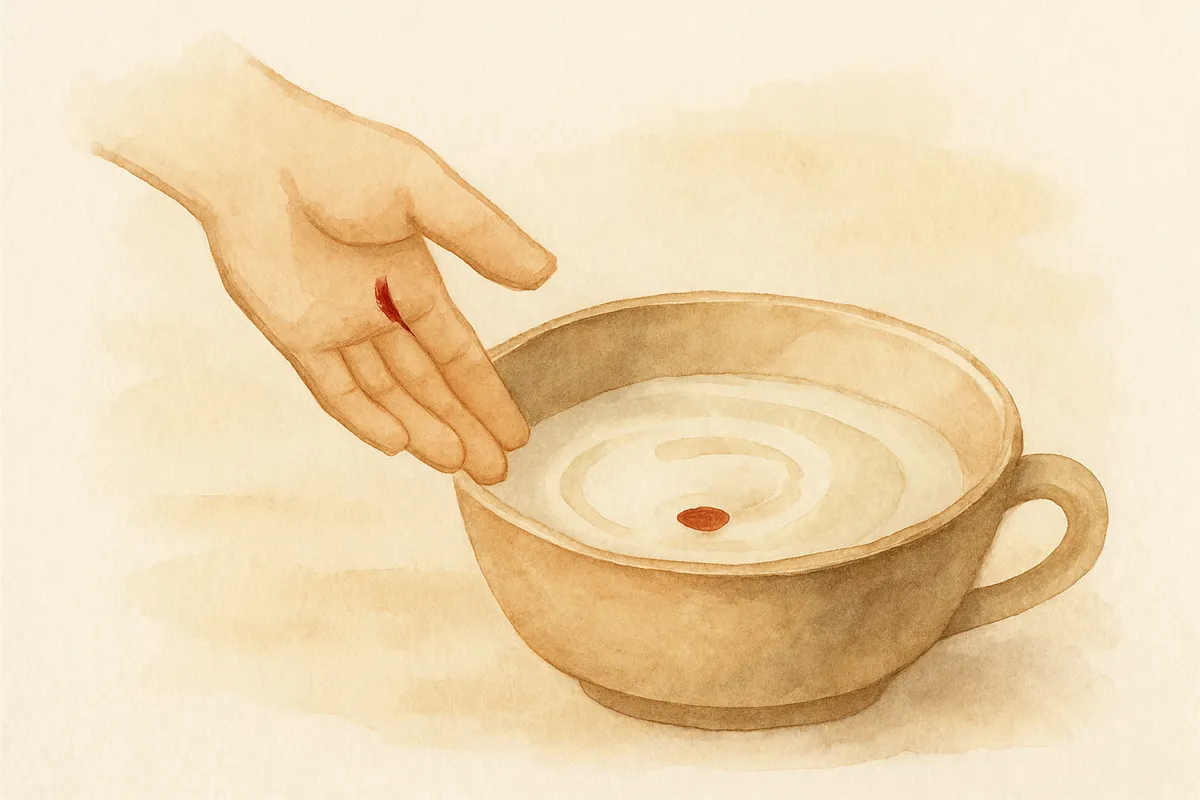
The blood from a living human being that falls into food does not render it forbidden, and the food need not be thrown out. Human blood is not subject to the same Torah prohibition as animal blood — the Biblical ban applies specifically to the blood of animals and birds, not humans.
Key Takeaways
- The Torah's prohibition on blood applies to animal and bird blood, not human blood.
- Human blood that falls into food does not make the food forbidden.
- However, there is a Rabbinic concern about consuming human blood that appears as blood (e.g., on bread or visible in food) due to the "appearance" problem (mar'it ayin / marit ha-ayin).
- If the blood is not visible in the finished dish (e.g., dissolved into a soup), there is no concern at all.
- If it is visible, one should remove it or avoid eating that portion, but the rest of the dish remains permitted.
The Torah Prohibition on Blood
The Torah states clearly in [Leviticus 17:10-14]:
"וְאִישׁ אִישׁ מִבֵּית יִשְׂרָאֵל... אֲשֶׁר יֹאכַל כׇּל־דָּם" "Any man of the house of Israel... who eats any blood — I will set My face against that soul..."
And in [Deuteronomy 12:23]:
"רַק חֲזַק לְבִלְתִּי אֲכֹל הַדָּם כִּי הַדָּם הוּא הַנָּפֶשׁ" "Only be strong not to eat the blood, for the blood is the soul."
The reason given is theological and spiritual — blood contains the nefesh (life-force/soul) of the creature. This is why its consumption is so serious for animal blood.
Why Human Blood Is Different
The Talmud [Keritot 20b] makes clear that the Biblical prohibition is limited to the blood of permitted and forbidden animals and birds — not humans. Human blood does not carry the same nefesh-based prohibition in Halachic terms regarding basar (flesh/meat) consumption laws.
The Shulchan Aruch (Yoreh De'ah 66:10) codifies this distinction, ruling that human blood is not Biblically forbidden.
The Rabbinic Concern: Mar'it Ha-Ayin
However, the Rabbis did impose a restriction: one may not eat human blood when it is visibly recognizable as blood, because an observer might think you are eating forbidden animal blood. This is the principle of mar'it ha-ayin (appearance of wrongdoing).
Practical examples:
- Blood on your lip or finger — you may lick it off, since it is clearly coming from your own body and there is no concern of appearances.
- Blood visibly on bread or food — one should scrape or wipe it away before eating that portion, but the rest of the food is fine.
- Blood that has dissolved invisibly into a soup or dish — no concern whatsoever; the food is entirely permitted.
Practical Bottom Line for Your Question
In your case — a small cut that bleeds a little into something you're cooking:
- If the blood has dissolved into the dish and is not visible, the food is completely permitted.
- If there is a visible spot of blood in the food, remove that portion and the rest is fine.
- The dish does not need to be thrown out in any scenario.
For personal guidance on a specific situation, consult your local rabbi or posek.
Sources
People Also Asked
Want to dig deeper?