Did every tribe have their own flag or was there 4 flags each for the groups of 3
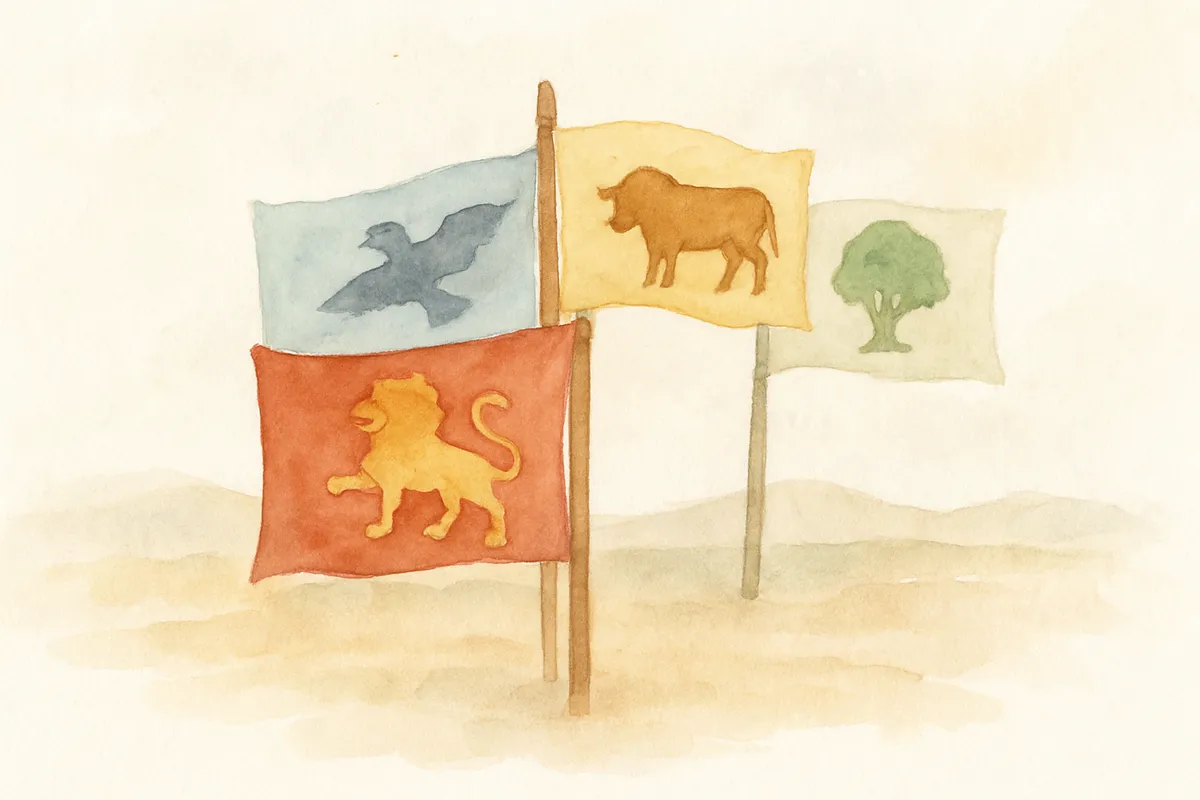
Great question! This is actually a fascinating debate among the classical commentators, and the answer depends on how you read a key phrase in Numbers 2:2.
Key Takeaways
- The Torah's phrase "איש על דגלו באותות" ("each man by his flag, with signs") is the source of this debate.
- The plain reading supports 4 large flags, one per camp-group of three tribes.
- A deeper reading of "באותות" ("with signs/banners") suggests each tribe — or even each family — also had its own smaller banner.
- The Netziv (Ha'amek Davar) goes furthest, arguing each beit av (ancestral family unit) had its own sub-banner.
- Ibn Ezra focuses on the purpose: preventing the tribes from mixing with one another.
The Four Major Flags
The primary structure described in Numbers 2 is clearly four camps, each with its own degel (flag):
- East — Judah, Issachar, Zebulun [Numbers 2:3–9]
- South — Reuben, Simeon, Gad [Numbers 2:10–16]
- West — Ephraim, Manasseh, Benjamin [Numbers 2:18–24]
- North — Dan, Asher, Naphtali [Numbers 2:25–31]
The Torah states: "וַיְדַבֵּר ה' אֶל מֹשֶׁה וְאֶל אַהֲרֹן לֵאמֹר: אִישׁ עַל דִּגְלוֹ בְאֹתֹת לְבֵית אֲבֹתָם יַחֲנוּ בְּנֵי יִשְׂרָאֵל" — "God spoke to Moses and Aaron saying: Each man by his flag, with signs (be'otot), according to the house of their fathers, shall the Children of Israel encamp." [Numbers 2:1–2]
The Debate: What Does "Be'otot" (באותות) Mean?
This is the crux of the question. The word "be'otot" — "with signs" or "with banners" — is separate from the word degel (flag), and commentators interpret this distinction differently.
Opinion 1: Only 4 Flags (One Per Camp)
Ibn Ezra reads the verse functionally: the purpose of the flags was simply that "shelo yit'arev shevet degel im shevet degel" — "so that one tribe's camp would not mix with another's." [Ibn Ezra, Numbers 1:52]
On this reading, the organizational unit is the four-camp structure, and the flags serve that macroscopic purpose.
Opinion 2: 12 Tribal Flags Plus 4 Camp Flags
The Midrash Bamidbar Rabbah (2:7) — based on your training knowledge — describes each tribe having its own distinctive colored flag corresponding to the gem on the Choshen (High Priest's breastplate). This implies each tribe had its own banner, in addition to the four major camp flags.
- Reuben's flag: red with mandrakes (duda'im)
- Judah's flag: sky-blue with a lion
- Dan's flag: sapphire-colored with a snake
- etc.
This is hinted at by the Netziv's reading of the "otot" (signs) as referring to tribal symbols — citing examples like "le'Reuven duda'im u'le'Yehudah aryeh" — "for Reuben, mandrakes, and for Judah, a lion." [Ha'amek Davar, Numbers 2:2]
Opinion 3: Each Family (Beit Av) Had Its Own Sub-Banner
The Netziv (Ha'amek Davar) takes this the furthest. He argues that the specific word "otot" (signs) — rather than simply "al diglo" (by his flag) — implies a two-tier system:
Each tribe had its large flag (degel), but each beit av (ancestral household/family unit within the tribe) had its own smaller banner (ot), numbered 1, 2, 3, etc., bearing the same symbol as the larger tribal flag.
[Ha'amek Davar, Numbers 2:2]
This gives us potentially hundreds of sub-banners beneath the 12 tribal flags, beneath the 4 great camp flags — a beautifully organized military and spiritual hierarchy.
Why the Distinction Matters: Levi
It is worth noting that the tribe of Levi is conspicuously absent from the four-camp system. The Or HaChaim raises this tension explicitly, noting that Levi is not counted among the 12 tribes in the census (Chumash HaPekudim) or the flag system. [Or HaChaim, Genesis 49:28]
Rashi explains that when Joseph's two sons Ephraim and Manasseh replaced Joseph and Levi in the tribal count, the number 12 was preserved for the degalim (camp flags). [Rashi, Genesis 48:6]
Levi camped around the Mishkan separately, serving as a protective inner ring, and therefore had no flag in the four-directional camp system.
Summary of Positions
| Opinion | Source | Structure | |---|---|---| | 4 flags only | Ibn Ezra | One per camp-group of 3 tribes | | 4 + 12 tribal flags | Midrash Bamidbar Rabbah | Each tribe had its own colored banner | | 4 + 12 + family banners | Netziv (Ha'amek Davar) | Each beit av had a numbered sub-banner |
The most widely cited traditional view — reflected in the Midrash and Netziv — is that there were both tribal flags and the four great camp flags, making the encampment a stunning multi-layered display of Israelite identity and order.
Sources
People Also Asked
Want to dig deeper?