Architecture of the bet hamikdash
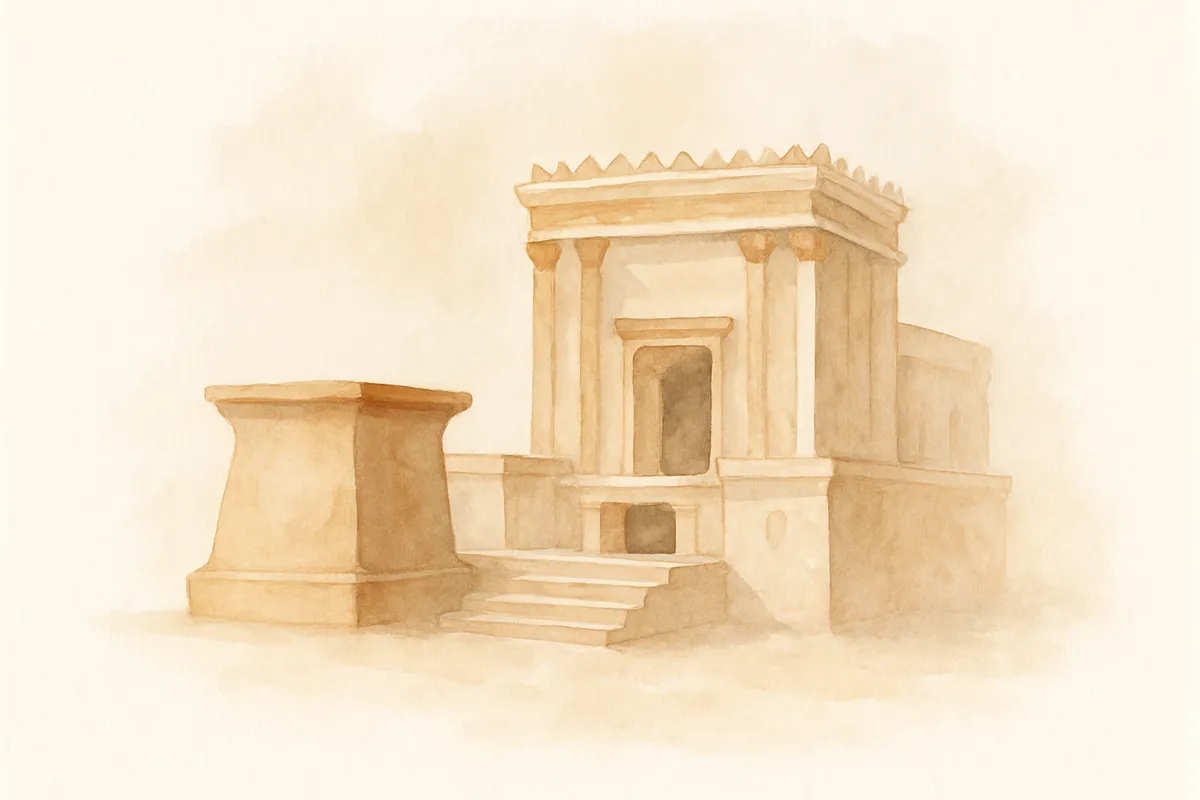
The Architecture of the Beit HaMikdash (Holy Temple)
The Beit HaMikdash (Holy Temple) in Jerusalem was a precisely structured sacred complex described in detail across the Torah, Prophets, and rabbinic literature. Its architecture was not merely functional — every measurement, material, and spatial arrangement carried profound theological meaning, expressing the Divine Presence dwelling among Israel. The most comprehensive architectural descriptions are found in Tractate Middot of the Mishnah and in the book of Ezekiel chapters 40–48.
Key Takeaways
- The Temple Mount complex was a series of concentric courts, each representing an increasing degree of holiness as one moved inward.
- The Kodesh HaKodashim (Holy of Holies) was the innermost and most sacred space, entered only by the Kohen Gadol (High Priest) on Yom Kippur.
- The primary architectural sources are Mishnah Middot, Tractate Tamid, Ezekiel 40–48, Exodus 25–27 (for the Tabernacle prototype), and Melachim (Kings) I:6.
- The First Temple (Beit Rishon) was built by King Solomon; the Second Temple was rebuilt under Zerubbabel and later dramatically expanded by King Herod.
- The Talmud states the Third Temple (Beit Shlishi) will descend from Heaven or be built in the Messianic era [Tractate Sukkah 41a; Rashi ad loc].
Overview of the Temple's Spatial Hierarchy
The Temple was organized as a series of nested sacred spaces, moving from the public to the increasingly holy:
1. Har HaBayit — The Temple Mount
The outermost area, accessible to all, including non-Jews.
- 500 cubits × 500 cubits square [Mishnah Middot 2:1].
- Surrounded by a wall with gates; most famous is the Sha'ar HaShushan (Shushan Gate) on the eastern side.
2. Ezrat Nashim — The Women's Court
- A large outer courtyard where Israelite women (and men) could gather.
- Dimensions: 135 cubits × 135 cubits [Mishnah Middot 2:5].
- Featured four chambers in its corners and fifteen semicircular steps leading up to the Nikanor Gate.
- The famous Simchat Beit HaShoeva (water-drawing celebration on Sukkot) took place here, with galleries built for women to watch [Mishnah Sukkah 5:2].
3. Ezrat Yisrael — The Israelite Court
- The area within the Nikanor Gate where Jewish men would stand during sacrificial rites.
- Narrow strip: 11 cubits deep [Mishnah Middot 2:6].
4. Ezrat Kohanim — The Priestly Court
- Reserved for the Kohanim (priests) performing the Temple service.
- Contained the great Mizbe'ach (Altar) and the Kiyor (laver for priestly washing).
The Mizbe'ach (Altar)
- The outer altar for burnt offerings was made of unhewn stones — no iron tool could touch it [Exodus 20:22; Mishnah Middot 3:4].
- Dimensions in the Second Temple: 32 cubits × 32 cubits at the base, rising in stepped tiers to 10 cubits height.
- The Kevesh (ramp) led up its southern side — no steps, to preserve dignity [Exodus 20:23].
The Heikhal — The Main Sanctuary Building
The Sanctuary building itself was divided into three parts:
Ulam — The Vestibule (Entrance Hall)
- The grand entrance porch, 100 cubits tall and 100 cubits wide [Mishnah Middot 3:7 — in Herod's expansion].
- Featured two massive pillars in Solomon's Temple: Yachin and Boaz [Melachim I 7:21].
Kodesh — The Holy Place
- The main sanctuary chamber, 40 cubits long × 20 cubits wide × 40 cubits high.
- Contained the three sacred vessels:
- Menorah (seven-branched candelabrum) — on the south side
- Shulchan (Table of Showbread) — on the north side
- Mizbe'ach HaZahav (Golden Incense Altar) — in the center, before the Parochet
- Two Keruvim (cherubim) overlaid in gold stood on either side of the incense altar [Exodus 25:18-20].
Kodesh HaKodashim — The Holy of Holies
- The innermost chamber, a perfect cube: 20 cubits × 20 cubits × 20 cubits.
- Separated from the Kodesh by the Parochet (curtain) — actually two curtains with a cubit of space between them in the Second Temple [Mishnah Yoma 5:1].
- In the First Temple: housed the Aron HaKodesh (Holy Ark) with the Luchos HaBrit (Tablets of the Covenant), Aaron's staff, and the jar of manna [Melachim I 8:9; Hebrews tradition].
- In the Second Temple: the Ark was hidden (according to tradition, by King Josiah [Mishnah Shekalim 6:1-2]); the space was left empty — the Kohen Gadol placed the incense there on Yom Kippur.
Materials and Construction
First Temple (Solomon's)
- Cedar and cypress wood from Lebanon, provided by King Hiram of Tyre [Melachim I 5:20-24].
- Gold overlay on interior walls, floor, and all vessels [Melachim I 6:21-22].
- Ashlar stonework — cut off-site so no iron tools were heard on the Temple Mount [Melachim I 6:7].
- Construction took 7 years (though Solomon's own palace took 13 — a detail noted by the Sages as significant) [Melachim I 6:38-7:1; Sanhedrin 104b].
Second Temple / Herodian Expansion
- Herod dramatically expanded the Temple Mount platform using enormous retaining walls (the Western Wall / Kotel is a remnant of this).
- The Talmud records: "Whoever has not seen Herod's building has never seen a beautiful building in his life" [Bava Batra 4a].
- White limestone and gold facing gave it a dazzling appearance.
Levels of Holiness (Kedushat HaMakom)
The Mishnah in Tractate Kelim 1:6-9 enumerates ten ascending levels of holiness:
| Level | Place | |-------|-------| | 1 | Land of Israel | | 2 | Walled cities | | 3 | Jerusalem | | 4 | Temple Mount | | 5 | Chel (rampart) | | 6 | Women's Court | | 7 | Israelite Court | | 8 | Priestly Court | | 9 | Between the Porch and Altar | | 10 | Holy of Holies — the apex of holiness |
Theological Significance of the Architecture
Rambam (Maimonides) explains that the Temple's concentric design was not merely architectural but educational — gradually drawing the worshipper inward toward awareness of the Divine [Moreh Nevuchim (Guide for the Perplexed) 3:45].
Ramban (Nachmanides) sees the Temple as a permanent re-expression of Matan Torah (the Sinai revelation) — the *Kodesh Ha
Sources
People Also Asked
Want to dig deeper?